It’s been 15 years since I first played this game, Radiant Dawn. To say that I have nostalgia for this game would be an understatement. Ever since I found it in a GameRush store around 15 years ago, I have replayed it endless times, debated about its tier list, and admired it a great deal for its ambition and successes. Just listening to Echoes of Daybreak, the music for the first map, is enough to make me emotional.
Every so often, I come back to the Tellius games, to revisit what I think is an incredible and unique duology, especially by the standards of the time of their release. I was very surprised by my latest playthrough of Path of Radiance, where I re-discovered a classic that, while it had dated gameplay elements, had an incredibly prescient story for today’s political climate. It had incredible writing, a great cast, and a surprising amount of nuance for an observant audience. It’s a game that trusts the player to understand it, and it has only rewarded me more the more I grow.
With all of these expectations, I started Radiant Dawn kind of reluctantly. I know that it pays off a lot of setup from Path of Radiance, and I already know how severely flawed it is. But I kept hope that it will hold up.
Still, like Sonic Heroes before it, I have to be critical before I am nostalgic. How did Radiant Dawn fare, and is it a coincidence I stopped posting for more than a month after I finished it?
Act I – Setting The Stage
Ambition on a Deadline: The Game That Nearly Ended Fire Emblem
It’s no secret that, despite their critical success, the Tellius games almost completely killed Fire Emblem. Radiant Dawn is the game that has sold the least amount of copies in the international market, barely breaking 500k global sales on one of the most popular consoles of all time, the Wii.
That might not sound horrible, but the scope and ambition of this game was off the charts. It is evident that Path of Radiance had a sequel planned in its story, with a lot of unresolved tensions and plot points ready to be easily picked up by its sequel.
This game famously has a 4-part structure, making it the longest game in the franchise until Three Houses got published almost 15 years later. And yet, its development time was relatively small: Path of Radiance released in April 2005, and Radiant Dawn followed in February 2007. This means it hat a short dev cycle—around 1 year and 9 months—with a modest dev team. Only about half worked on gameplay, with the other half focused on cutscenes.
I know that I don’t usually like talking about a game’s dev cycle in my reviews, but I can’t help feeling the feeling that our version of Radiant Dawn is an incomplete game. Not as a product, mind you. As a product, the game looks and is finished—but thematically and mechanically, I’ll aim to show enough evidence in this review that a lot of pragmatic decisions were likely made to deliver a full product by its deadline.
A Botched Localization?
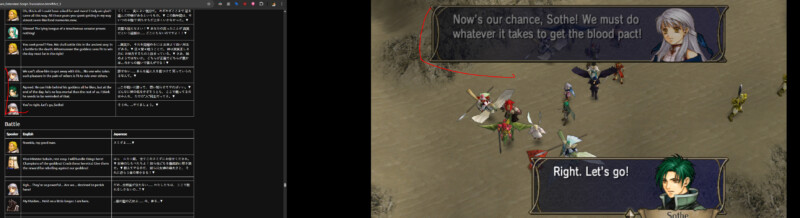
I am not sure if this is common knowledge today, but Radiant Dawn actually has two scripts. One is the “simplified” script and one that the community has nicknamed the “extended script”, exclusive to Japan’s Hard Mode. If you want to read more about that, you can read this article, but the TL;DR is that the author theorizes that someone thought that the script was too dense and had editors create a “simplified” version, which, oddly, was then placed on the Normal difficulty.
The problem is, the international version only localized the simplified script. The extended one has remained exclusive to Japan for this game’s entire history.
The picture above shows me using my dual-screen setup to see the extended script on my left screen while I played the game on the right one,—doing a literal line-by-line comparison of both—thanks to a kind Reddit user who only one year ago published a full translation of Radiant Dawn’s extended script, making it available for most players for the first time… if they’re willing to go through the inconvenience of following along.
I’d say that around 10% to 15% of the dialogue was cut or otherwise modified to make the story “easier to follow”. Characters were simplified, war logistics were stripped down, and political commentary was removed. Personally, I feel it’s insane that I have played this game for almost two decades and I only experienced a dumbed-down version of its story, which I will talk about more soon, but just know that, despite the big picture remaining largely intact, we lost a good amount of context.
I take this as evidence that even the localization was rushed; they opted to just complete and publish it as soon as possible instead of giving us the full story, but I guess we’ll never know. This already makes the game harder to review, since this setup was extremely inconvenient and I essentially read almost the whole game twice.
A Grander, More Epic Story
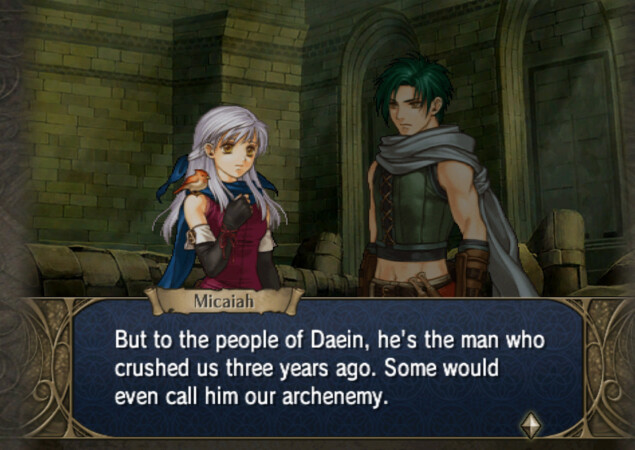
After the Mad King’s War, Crimea focused on rebuilding instead of ruling over Daein—not to mention that Queen Elincia probably didn’t even want to rule over another nation. So it was instead left to the administration of the Begnion Empire, who installed a brutal regime that has taken advantage of its citizens ever since.
And this is where our story starts: within Daein’s point of view, following the Dawn Brigade, a rogue band of freedom fighters looking to take control away from Begnion’s occupation.
This is already a great setup for Path of Radiance’s sequel, and it doesn’t lose any time in using it as a backdrop: characters comment on the consequences of the war, Micaiah brings up how Ike is actually not a hero for Daein, and we get a chance to take control of the nation that we fought against in the last game.
Very early on, Radiant Dawn starts to show what makes it special: its commitment to tell a grand story, and its almost unflinching commentary with historical parallels and geopolitics. I am once again extremely impressed that a game like this was greenlit and published internationally by Nintendo.
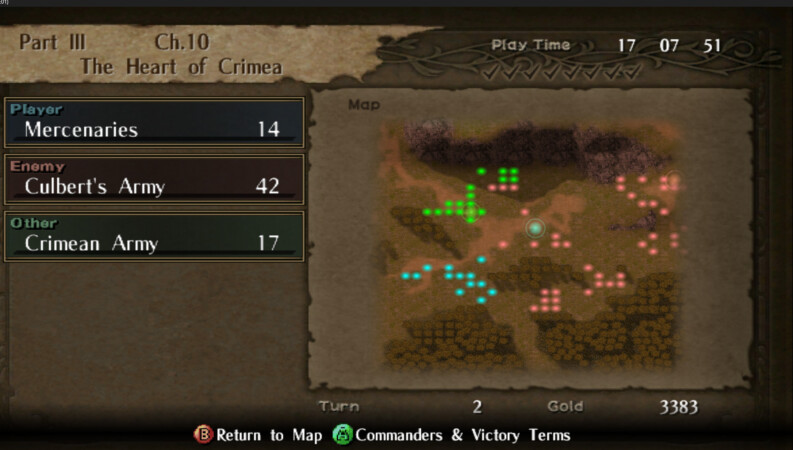
This regional conflict quickly turns into an endlessly escalating continental struggle, with almost every country having some impact on it. This allows battles that are much grander than any other game in Fire Emblem history up to that point—and from what I’ve seen from post-Awakening games, probably since.
This same structure, however, also quickly shows one of this game’s more egregious problems.
A Middling First Act
In Path of Radiance, we have an entire first act dedicated to just introducing its characters, setting up a conflict, and setting up the personal stakes for the protagonists. Despite its smaller scope, I’d bet that most players have grown attached to the Greil Mercenaries, and PoR’s cast remains a fan-favorite among its players.
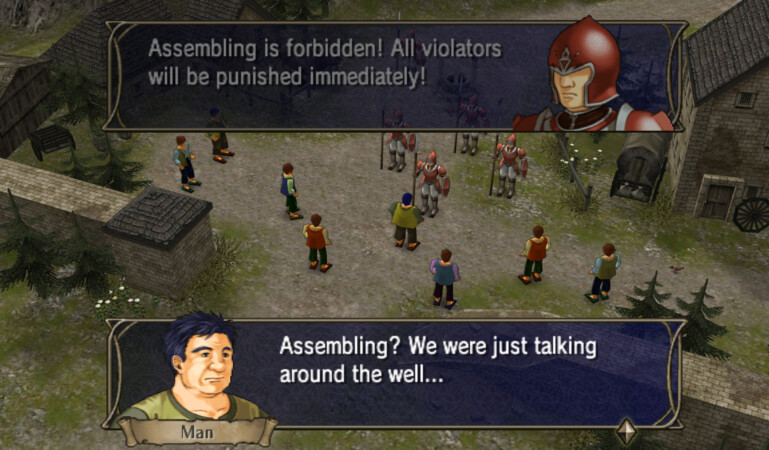
But in Radiant Dawn, the story kicks directly into war. Within one or two chapters, we are thrust into live conflict, with very little time to know the Dawn Brigade and establish the stakes into the conflict. What feels like an attempt by the writers to establish urgency quickly instead makes the Begnion Occupation Army look like cartoon villains—killing random people and even their own soldiers for minor infractions—which makes it hard to take the conflict seriously.
This is the first piece of evidence that leads me to think that maybe Radiant Dawn might not be a fully realized game. In Path of Radiance, despite Daein being the unambiguous aggressors and deeply racist, there were a lot of moments that showed the Daein population are still human. Ashnard himself had a consistent ideology and explicit goals that explained his actions, making him a memorable antagonist.
The same can’t be said of Jarod, who seems to be a simple power-hungry buffoon. The texture of Part’s 1 story is flattened by a bunch of mustache-twirling villains, a strange fit in a game otherwise commenting on power struggles and ruler legitimacy.
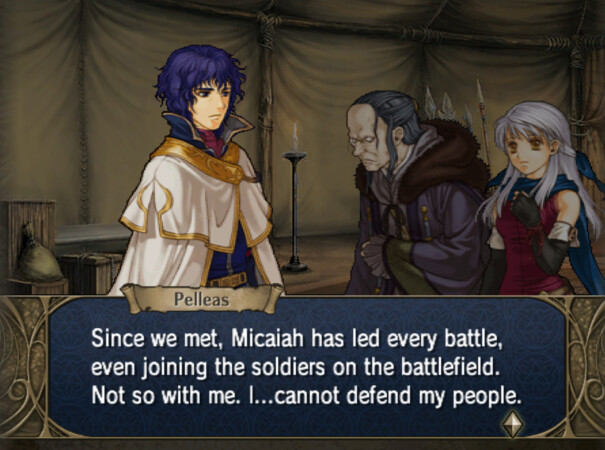
It’s arguably Part 1 is the one that suffers the most from the simplified script. We already get weaker characterization from the Dawn Brigade members as “unimportant” lines are cut, Begnion is somehow more one-dimensional its localized portrayal, and we also lose a lot of war logistics and exploration on what it means to be a ruler—a key part of Pelleas’s arc. His relationship with Micaiah is almost completely stripped of the humanity or shared identification they had in the original script, which is thematically odd as Pelleas is clearly meant to be a foil to Micaiah.
Not to say that the extended script fixes all of this, of course, but it at the very least feels like a more complete and serious story, despite having similar pacing issues.
Tragically, the fix here would be to make the game even longer than it already is by adding chapters that spend time with its characters and explore different perspectives and internal conflict. But given that Radiant Dawn is already a massive game, I can see why that didn’t happen. Still, on this playthrough I felt like I didn’t get a complete and fulfilling story in Part 1, and while still important in terms of plot, it leaves kind of a sour taste in my mouth that it’s the foundation for the rest of the game.
Act II – The Middle Game
Political Intrigue and Gameplay Cracks
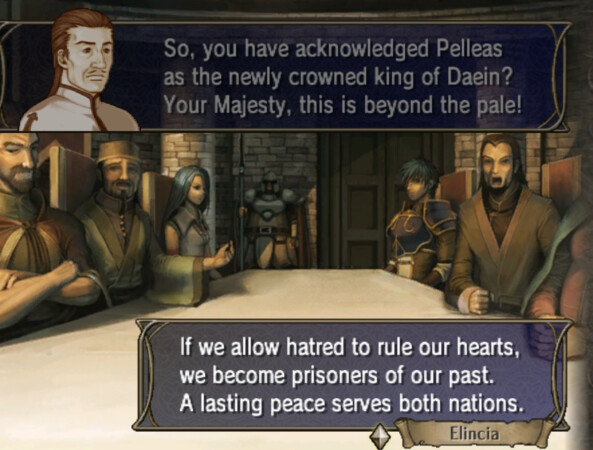
Part 1 ends with Daein’s revolution successfully toppling the Begnion Occupation Army and regaining independence, which triggers massive national anxiety within Crimea, still haunted by the Mad King’s War. This directly leads us to Part 2, which is commonly referred to as “filler” by most people.
I guess it depends on how you qualify on what “filler” means; I’d argue that the Tellius games follow two main ideas: Path of Radiance seems to be about the day-to-day struggles of people affected by war and displacement, whereas Radiant Dawn is a lot more about the broad geopolitical forces that encourage nations to go into conflict with each other.
In this regard, Elincia’s arc in both games is a mirror of that. In Path of Radiance, she is a traumatized young woman who is trying to take responsibility for her lost homeland and, more importantly, for the subjects she will rule over. But as it turns out, getting your nation back doesn’t give you a happily-ever-after—indeed, now Elincia needs to have difficult political conversations with the aristocracy, and keep her nation at peace despite the increasing anxiety that Daein has over Crimeans.
She struggles now with upholding her values for peace and protection while responding to threats that put herself and the people she loves in danger.
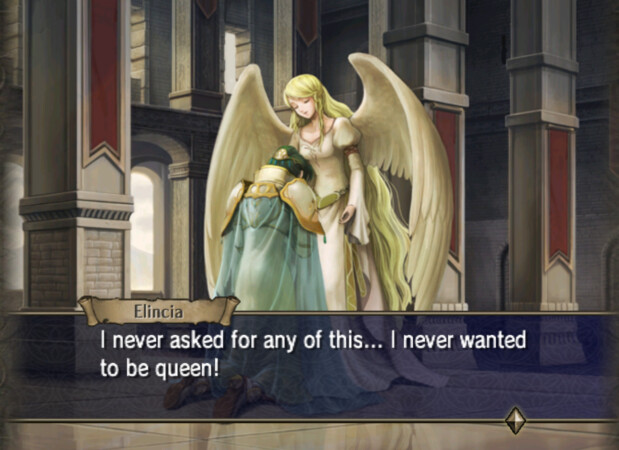
Narratively, Part 2 is my favorite part of the game. It’s the most cohesive, doesn’t meander, has no glaring story problems, and every character that appears is very well-integrated into the story.
Importantly, it’s also the one that follows up with a Path of Radiance protagonist the most—we’ll get to Ike in a moment—, providing a logical continuation of her story that remains topical to the larger plot: after all, one country’s revolution can cause ripple effects in its neighbors. This is not all I have to say about Elincia, but the game’s structure makes it hard to keep things clean.
Unfortunately, this is also where the game’s uglier gameplay patterns start to emerge.
Divided Armies, Divisive Gameplay
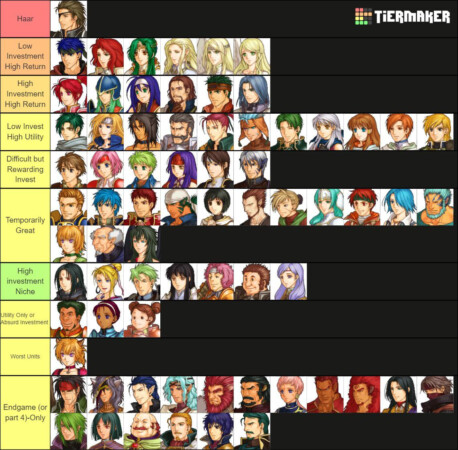
Part 2 introduces one of the more controversial aspects of Radiant Dawn: shifting viewpoints and commanders. As a gameplay design choice, I am very split on this decision.
I’m not sure if it was intentional, but usually, the canonical power level of each army is reflected in each chapter’s difficulty. Part 1 pits inexperienced revolutionaries against a professional army, making the hardest part of the game. Part 2 reverses this: you now control professional Royal Knights, and fight a group of rebels that are sometimes canonically inexperienced bait. In this sense, Radiant Dawn does an excellent job at reinforcing story stakes through gameplay difficulty.
However, it also means that a lot of units are hilariously overpowered, almost useless, or oscillate between both roles. Radiant Dawn’s revolving door structure makes it so most units’ availability limited, so it’s very hard to invest in “Est archetypes”, and the reward that you get for it is not even worth it (and we’ll get back to this later). It’s especially bad for first-time players, who might not be aware of the structure of Radiant Dawn and invest into units like Edward or Leonardo, despite they invariably falling off unless you spend an ungodly amount of experience into them.
I think it’s completely fine to expect that Fire Emblem gives you “growth units” to invest in at this point, so players that go into Radiant Dawn expecting something similar are in for a surprise.
This makes this game’s gameplay very hard to judge. Should you appreciate the way story and gameplay reinforce each other, even at the cost of unpredictability? Or is Radiant Dawn simply handling its multiple armies poorly? It’s impossible to judge, since this is the only time Fire Emblem has attempted something like this.
Thus, the difficulty curve is almost schizophrenic. The first chapter of Part 1 is relatively difficult, but serviceable as an introduction. It escalates into some hard challenges, until you get several grossly overpowered units. Then the Crimean Royal Knights show up, and while their objectives are more varied, most of your characters can trivially clear out maps without much risk.
The above list is one of many. Certainly, there are a lot of characters I would disagree on, but notice that the tier lists does not put most characters above others. Is Stefan, a lategame menace that is virtually only playable in Tower of Guidance, a better character than Gatrie, that is a solid but not overpowered unit for the entirety of Part 3? How the hell would we even make the comparison?
Let’s talk more about gameplay balance.
Same War, Different Leagues
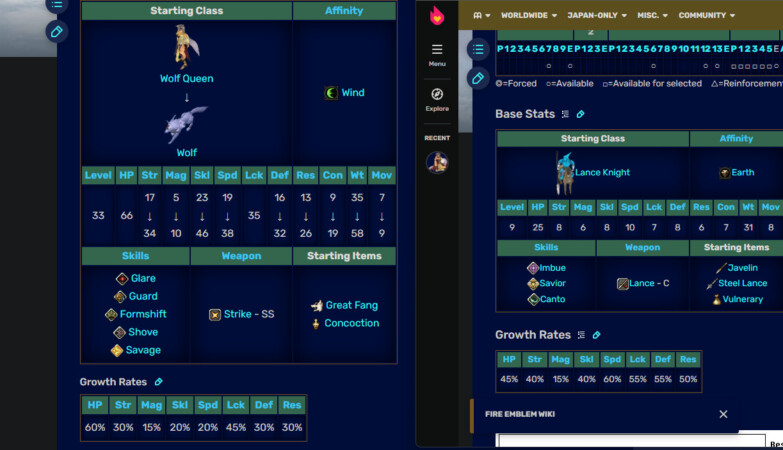
The fact that the story in Part 1 feels slightly rushed is one piece of evidence that the game might not have been fully finished, but the evidence ramps up after Part 1.
I’ve already mentioned balance, and while I praise Radiant Dawn’s (alleged) commitment to reinforcing story through, the degree of difference between unit quality is laughable.
There is no way to compare a character like Fiona—who has absurdly low stats, is arbitrarily barred from fighting in some chapters and gets screwed by terrain in the chapters that she is available—with Nailah, who has similar availability, higher movement, and infinite Laguz transformation. Her untransformed states are higher than Fiona’s base states.hoi
Of course, following the “gameplay reinforces story” angle, this makes sense—Nailah is a laguz royal, which means that she is canonically the strongest in her tribe, while Fiona is just the leader of a minor town in Daein with no battle experience. But this is only the most extreme example.
We have characters like Astrid and Geoffrey, Leonardo and Edward, Meg and Jill, Gareth and Nasir, countless examples of characters that join in the same chapter or with 1 chapter of difference and are wildly different in quality, with Radiant Dawn having the franchise’s biggest cast, and is already struggling to balance time between its important members, it begs the question: why introduce so many characters if they’re going to be fodder in both story and gameplay?
It makes more sense, however, if you think of Radiant Dawn as incomplete. It feels as if the devs intended to do more with these characters—maybe through supports or minor perspectives like Sothe and Tormod in Path of Radiance, which made the world a little bit fuller—and just didn’t have the time to develop these placeholders. We could have had reasons for game-breaking units to not completely overshadow weaker comrades, and reasons for weaker units to be worth playing.
Uneven Character Work
Part 3 might be both the best part and the worst part of the game. It takes a diplomatic spat and turns into a continental conflict, in a suspenseful and engrossing story. In a direct continuation of Path of Radiance’s themes, it zooms out to explore how nation-stats act during crisis, how radicalization mobilizes armies into war, and how different sides interpret the same conflict.
It also sees the return of the beloved Greil Mercenaries, who have an entire game of baggage to stand on, and thus need far less development than the Dawn Brigade to carry their own stories
However, it also marks the start of sidelining main characters, underdeveloped themes, and outright plot contrivances that we’ll get to in a moment.
Nation-States Under Pressure
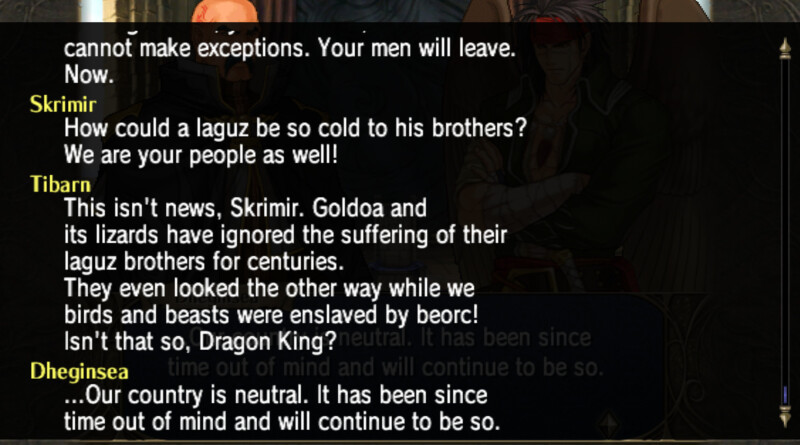
Part 3 is the largest part in the game, by a fair margin. The first half chronicles a successful offensive campaign by Gallia against Begnion, with the Greil Mercenaries as an elite strike force, after one of Gallia’s messengers is killed by the Senate.
An amazing thing that gets repeated over and over in Part 3 is how each action provides an escalatory response. Ignoring the awkward transition from Part 2 to Part 3, this pattern holds across the rest of the game: the Senate kills one man, and this somehow escalates to an apocalyptic event.
But what else are the Laguz supposed to do? They face attempted hunts, enslavement, and even a black market to tame and sell them. They’ve just discovered that the Senate orchestrated an assassination and scapegoated the heron tribe, producing a genocide. The Senate might be preparing for war regardless, and killing a messenger is a clear declaration.
And so we spend around six chapters with Ike’s team—skilled veterans who are a key part of Gallia’s success. While not extremely eventful, this part of the story lets us spend time with some characters, in what I wish would have happened with the Dawn Brigade, reestablishing Ike as a fully-grown character, who is going to be the beacon of reason for the rest of the game. We also get to see how Soren is doing, a few conversations between the Mercenaries, and how effective they are as an almost professional force. It perfectly creates a myth of “the heroes are back”.
Then we get other perspectives in the conflict. Daein gets three PoV chapters showing why they join the war, how racial motivations fuel their morale, and how they are ultimately used as pawns by Begnion to wipe out the laguz. Ironically, they are sacrificed so Begnion can claim to have eradicated the Laguz.
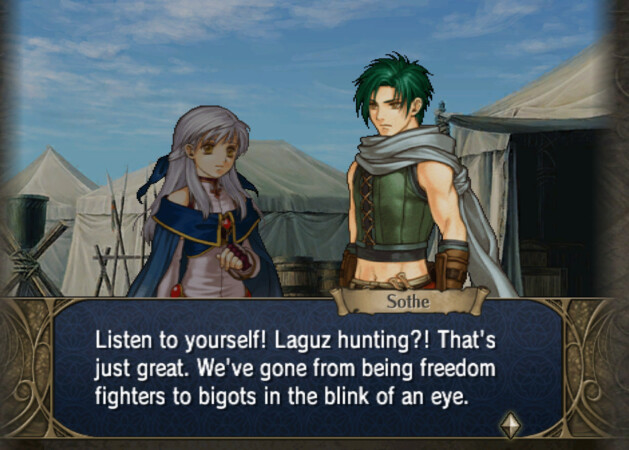
The irony is not lost on the Dawn Brigade, who spend time reflecting on the twisted logic of this conflict. Having two armies you directly control—both of which you have invested time in—is a genius idea that Radiant Dawn executes masterfully here. Every Dawn Brigade chapter is tense and full of things to say about their side of the war.
But Daein and the Laguz Alliance aren’t the only players. In an event I can’t help comparing to Germany’s invasion of Belgium in 1914, Begnion invades neutral Crimea, which forces Crimea to choose. This is handled with surprising care: Elincia is, of course, committed to peace, and tries to solve everything with mercy and compassion. But she also just learned that having a soft hand will cost more lives in the long run, and thus she instantly deploys the Royal Knights to keep civilians defended as Begnion starts pillaging Crimean homes.
Every side of the conflict seems to ask one question: how should nations and its rulers act when threatened? Elincia wants to rule and resolve peacefully, but when Begnion invades, they don’t really have a choice: they must side with Begnion by letting them through (and betraying their ideals and their allies by letting a genocide campaign go through its borders while taking resources from their population), or do they resist (and risk an a war with the country that just helped them reclaim sovereignty)? It is a hard and legitimate question that pressures Elincia into making decisions that put her values on the spot.
Every side has their own though decisions to make, and the story escalates naturally into a global conflict.
Not everything works that well, though.
Act III – Protagonists and Payoffs That Weren’t
The Protagonists Come Back
Part 3 already has a shaky start. Nothing about Part 2 really connects cleanly to Part 3—there’s no event in Part 2’s revolution that leads to Gallia knowing about the Serenes Massacre and push them to war. But the opening chapters of Part 3 are strong enough that it’s easy to forget how logical Part 2 felt as a continuation of Part 1.
Part 3 promises a lot. It pits both new and old characters against each other without offering a clear resolution to either of them, but it also starts sidelining both new and old characters.
While Soren gets a lot of moments to show his own character and a bit of his growth, Ike remains an idealized hero. He faces no personal conflicts, no arc that makes him question his loyalty. This isn’t necessarily a bad thing, it’s cool to see the protagonist of the previous game be a veteran leader with a successful career and strong morals. It is inspiring, and I assume meant to be a foil to Micaiah.
But we simply spend too much time with him. There are 15 Chapters in Part 3, and 11 of those Chapters are spent from Ike’s point of view (more than the entirety of Part 1). He is a static character with no internal conflict and no personal stakes; he is just a sword for hire. This is a stark contrast to Path of Radiance, where Ike’s morals were constantly tested as he traveled and learned about the wider world.
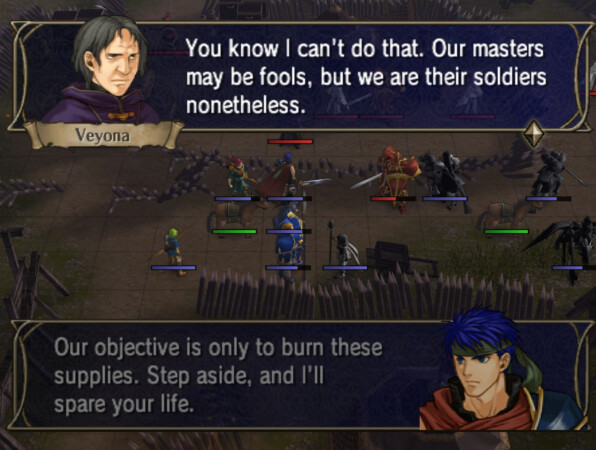
Do I hate Ike, or think it was a bad idea to include him? No. I love Ike, he’s my favorite lord. He’s undeniably a great character in Radiant Dawn, even if static. But with so many other characters who do have personal stakes in the conflict and who could be much more interesting to follow, it’s weird that we spend so much time with a character who has finished his arc.
And it doesn’t stop there: Mist, once a foil to Ike’s bravado and courage, who humanized him in Path of Radiance is almost completely gone. Her only contribution to the game is a vague tie to Lehran’s Medallion, reducing her to a plot device. If you only played Radiant Dawn (as I did at first), you’d be forgiven to think she is a largely inconsequential character.
Still, no Greil Mercenary gets it worse than Titania. With no need to show rookies the ropes and no support conversations to flesh her out, even the rest of the Greil Mercenaries, with just a couple of convoy conversations, feel more fleshed out than her. A few lines of agreement with Ike, and that’s it. Gone is the mentorship, the care for her team, the reliable second-in-command presence.
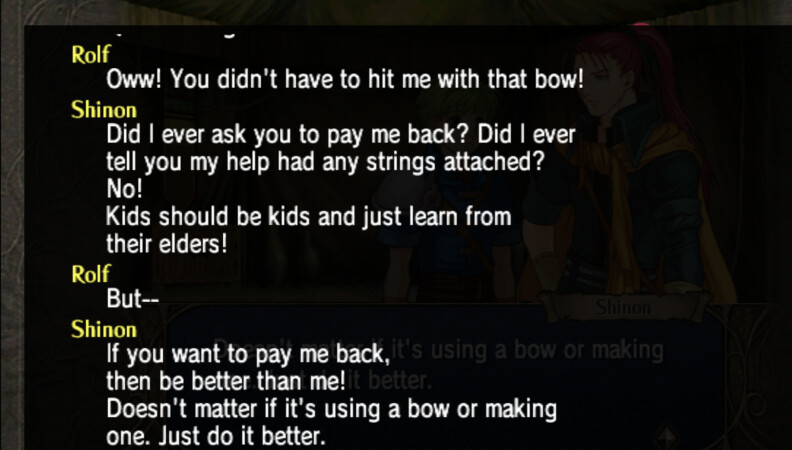
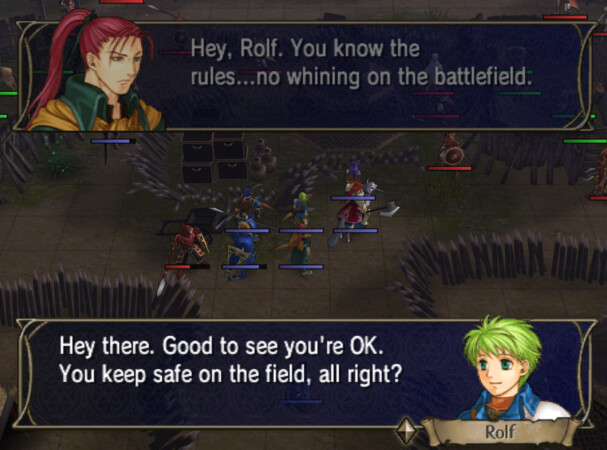
While the Greil Mercenaries do benefit from already starring in one game, without supports or subplots, they feel far flatter than in Path of Radiance, and not a lot of payoff is given to anything set in the previous game. There is no equivalent to Gatrie’s return to the Greil Mercenaries with Astrid, Shinon’s convoluted recruitment, Rolf wanting to join the fight despite his brothers’ warning—all the moment-to-moment that made the Greil Mercenaries feel like characters in a close-knit team is mostly gone.
There are a few amount of convoy conversations that have limited impact because these characters are already established, but the Mercenaries are mostly divorced from the conflict. This isn’t just a “why isn’t there more of a good thing?” gripe, it’s a legitimate gap. This army feels colorful only because it borrows from the previous game’s success.
Isn’t There More than One Protagonist?
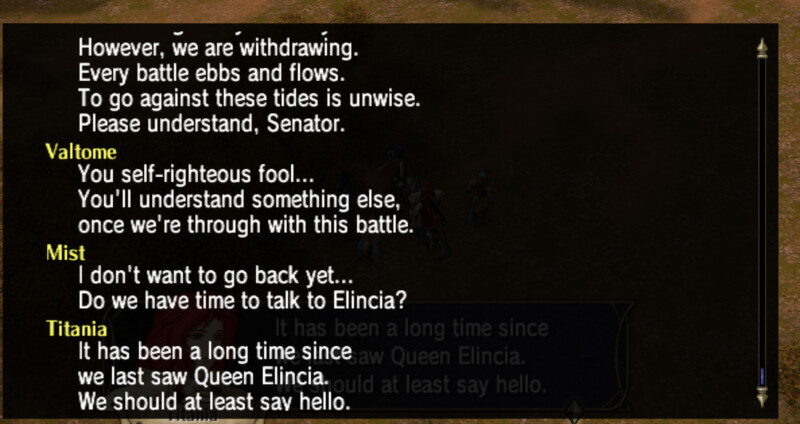
In some ways, Elincia is a ideal example of what sequels should strive to do with their original characters: her arc continues logically, which has thematic relevance to the entire game’s thesis (international war, realpolitik), and she doesn’t take the spotlight out from returning characters. She gets her Part 2 arc and is and then is mostly done.
…But hey, if everyone is involved, why is she sidelined so much?
Ike has no personal or moral stake in the conflict fought in Part 3. He is hired by Ranulf to fight for Gallia, and while he agrees Begnion must be stopped, his role is just being a moral beacon and a mercenary, mostly symbolic and strategic. Elincia, by contrast, faces a pressure point that tests her character: she learns that mercy alone can cost more lives than force, and then she makes the boldest move in either game—risking her life to resolve a clash peacefully.
It fails, and she becomes directly involved, hosting a meeting of the allied forces on Crimean soil. This is the perfect moment for Elincia to confront impossible questions: Will she sacrifice Crimean lives for an invasion of Begnion? Will she mediate between the Apostle’s Army and the Laguz Alliance? How existentially dangerous are Begnion’s actions, given that they have already disregarded Crimean safety?
And yet, after this action, Elincia gets almost completely forgotten. She becomes a figurehead in the narrative, stripped of agency. She has the opposite problem than Ike: she has more room to grow, has personal stakes in the conflict, and has power power that could steer the course of the current war. But all of that is cut. She has an amazing Part 2 arc, takes an iconic risk in Part 3, and then Radiant Dawn abandons Crimea’s perspective altogether.
Sadly, she is not even the character that got the shortest straw.
Setup for Payoff That Never Came
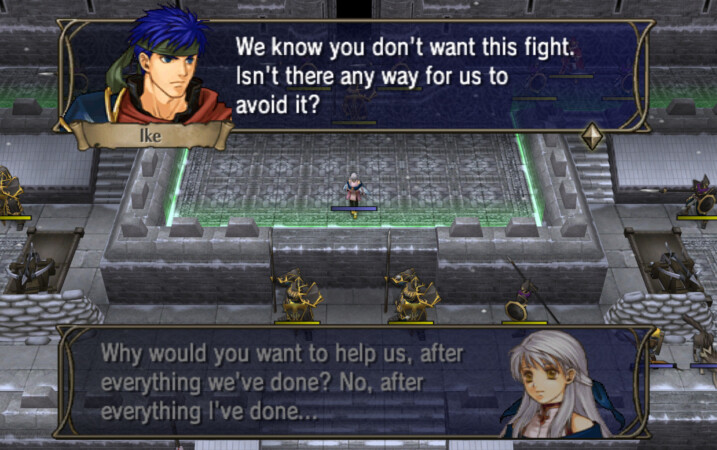
Micaiah is… complicated. She is, on paper, the most complex character in the game. She cares for those close to her, puts herself at risk constantly to lead Daein, and rejects Daein’s culture without becoming cynical, despite being a victim of it herself.
But she’s also a radical nationalist who leads a destructive war, tolerates atrocities to sustain morale, and allows a cult of personality to grow around her. By her own admission, most of her Part 3 actions should be condemned.
This should make her the perfect foil to Ike: he’s the meritocratic leader of a diverse army, she’s the nationalist who represents only Daein. Both fight from the front, both lead for independence, both embody clashing ideals.
Yet the clash never comes.
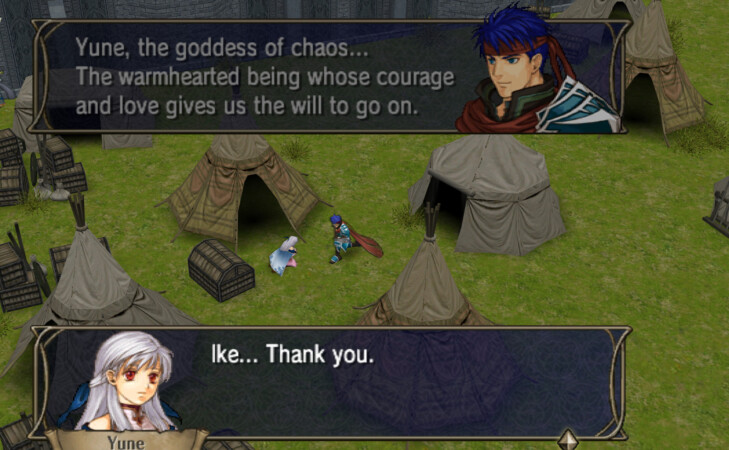
This would be the perfect setup to further develop Micaiah, and continue the criticism of Path of Radiance’s nationalism, now with a face that we can empathize better with and who has much better reasons to be nationalistic. But come Part 4, Micaiah gets almost completely stripped of anything resembling a character arc. Instead of confronting or being transformed by Ike, Micaiah simply vanishes into the role of a vessel for Yune.
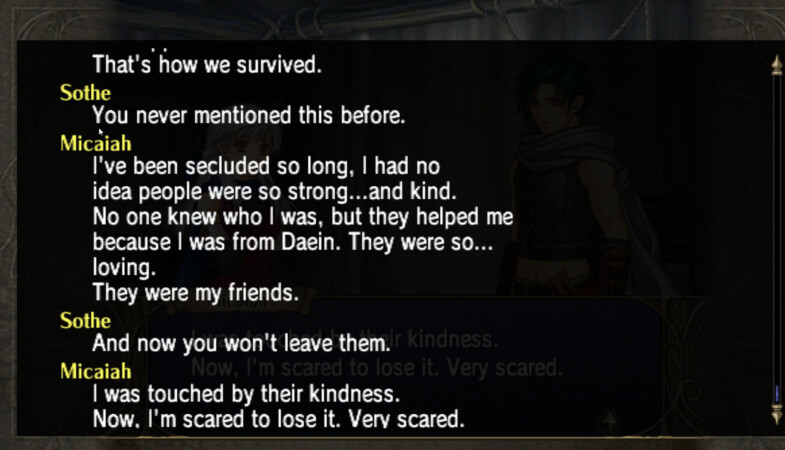
There is a small amount of discussion about Micaiah as a radicalized character, which is relatively subtle. The word “nationalism” is never mentioned, but Micaiah has a few reflections that take a look as to how she become so fiercely defensive about Daein.
Micaiah’s arc might be the starkest example of Radiant Dawn’s unfinished storytelling. It builds up a confrontation of two opposing ideals, then swerves away at the last second, refusing to commit to having an “evil” or “wrong” protagonist, and in the end, Micaiah gets away scot-free despite almost all of the Tellius duology being an indictment of people that act and think like her.
Still, she is still a kind person who wants a better world for everyone, and has a limited amount of foresight, so what could possibly compel her into fighting Ike?
The Blood Pact: Almost Ruining All of Tellius
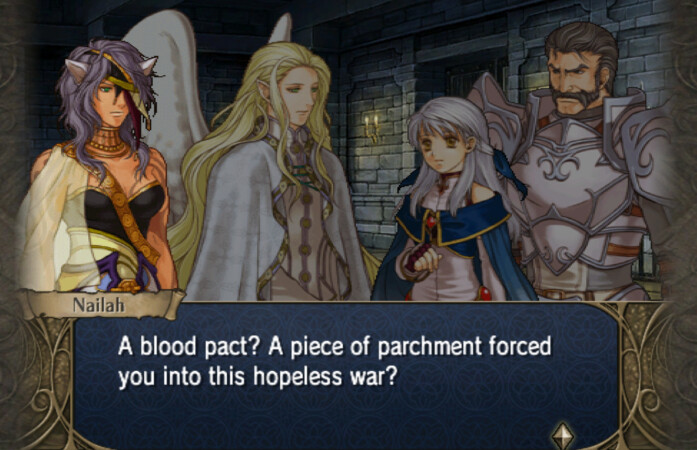
Picture yourself in the writing room of Radiant Dawn, in 2007. You’ve setup your antihero in Part 1, give a protagonist from the previous game her spotlight, and now you want to engineer a cash between your Part 1 antihero and Ike. But there’s a problem: your antihero fights for her nation’s prosperity, can sense emotions, and would show mercy every time. Ike, meanwhile, would never invade Daein without a cause. You put a pin on that and start working on the rest of the game.
Now, time is running out. The game needs to be published in a few months, and you’ve written yourself into a corner. What could possibly be your solution?
Magical blackmail, of course!
If Radiant Dawn is supposed to be a political thriller, that has commentary on prescient real life issues, there is no space for how the Blood Pact is employed in the story. As a plot device, it has power and implications so ridiculous that I can only guess that it was drafted into the script out of pure necessity. It turns the story into an analysis of how people with different views all have a reason to fight, into “we didn’t read the fine print and now need to aid a genocide”.
For Micaiah, this means following an arbitrary peace of parchment, having a vague notion that it is exactly as Lekain says it is, and continue to fight for Daein despite of it. It is not entirely without commentary—characters do debate whether fighting is just, even under the Pact—but the contrivance hollows out any nuance.
It feels desperate. The writers couldn’t justify Daein fighting, so they conjured an absurdly overpowered plot device to force it.
But the damage doesn’t end there. Naesala, a character portrayed as duplicitous but ultimately sympathetic in Path of Radiance, is likewise dragged into this mess. Likewise, it is retroactively revealed that Ashnard also played a gamble with the Blood Pact to gain power before the Mad King’s War.
This produces a domino effect where a lot of both Radiant Dawn’s story and Path of Radiance are tied to this stupid piece of paper that feels like an unfinished placeholder plot beat.
Still, there’s still some hope of salvaging the story: how will Micaiah act when tasked with an impossible decision, that puts her beloved country under an existential threat? How will Ike and Elincia face the fact that they are faced with an existential threat that is not backing down?
Act IV – The Endgame Slide
Deus Ex Machina
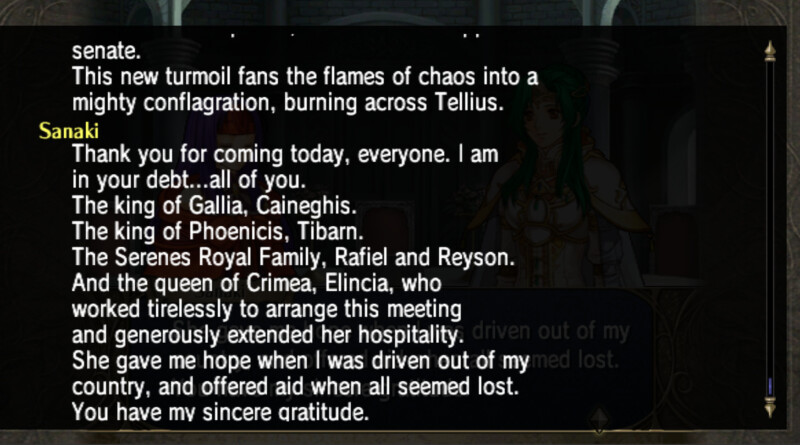
For all of the faults of Part 3, it still setup a tense and high-stakes scenario: Begnion is actively trying to genocide the Laguz, the Senate has usurped the Apostle, and Sanaki in turn unifies an army from Crimea, Begnion and the Laguz Alliance to get her throne. Begnion has already invaded neutral Crimea, and is using Daein as a sacrificial pawn for a strategic gain.
At this point, maybe the player is even meant to question who the “hero” really is, since now Ike is on the offensive. The chapter where the armies unify under Sanaki is literally titled “Just Cause” (3-11), which to this day I don’t know was meant sincerely or ironically.
The protagonist from the previous game and this one have clashed several times and are nearly at a standstill. The story seems to be pushing towards a resolution: either the war grinds down nations despite good intentions, or two sides can come into a mutual understanding despite their brutal history.
How about a story about how we need to fight a goddess instead?
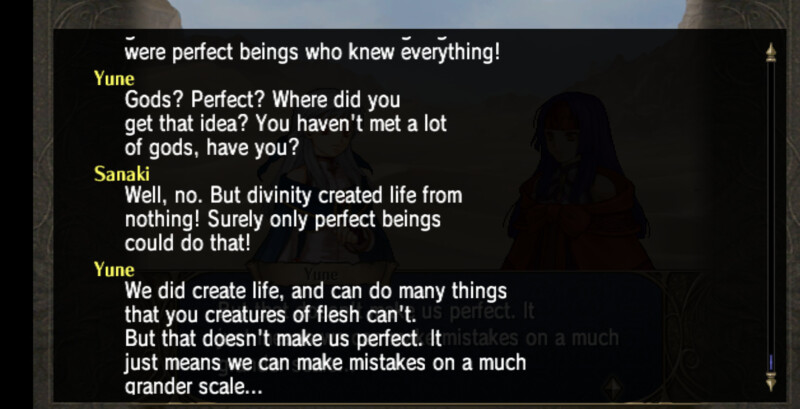
At the end of Part 3, the story collapses under a convenient reset button. Soldiers are turned to stone, and suddenly everyone has to cooperate against Ashera. Since no side had a convincing reason to fight in the first place, the game lets them drop the bloodshed and move straight into the Tower of Guidance. Yay!
…Look, I don’t necessarily think that the mythical intervention is uncalled for. It is heavildy foreshadowed all the way back in Path of Radiance, and it is a source of growing tension in Part 3 itself. Indeed, I think this might have been the plan since Path of Radiance itself was being written.
But why, oh why, would you use it to break the conflict that you have been building towards the whole game, instead of using it as an escalation?
Imagine if, instead, Daen had already joined the Apostle’s Army to stop Begnion once and for all. They finally set aside their differences, commit to continental war, and then Ashera awakens, judging all of them. The overall goal stays the same, but the stakes rise: now they fight with a smaller army, facing both empire and deity.
That would have been an escalation that still respect the cosmic stakes that Radiant Dawn obviously needed to include. But what we get instead is narrative deflation, and a quick and easy escape to a conflict that had been built up the entire game.
Silence In The Calm Before The Storm
We’ve had some good character moments, interesting questions, a tense escalation of conflict, and at least some moral testing of the leads. Despite a flat cast outside the core (and even within it—Titania, Mist), we’ve gotten worthwhile time with what I’d call the three main protagonists: Ike, Elincia, and Micaiah.
Now the whole continent is quiet, Soldiers are stone, the battlefield is suspended, and Part 4 opens a space for reflection. In fact, its first 6 Chapters don’t actually advance the plot that much; the community sometimes calls it “filler”, but I think that this would be a great time for the story to breathe, tie up loose ends, have good moments with each other, and reflect on what has been lost.
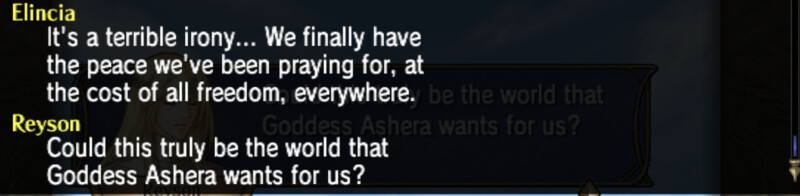
And yet… we get almost nothing,.
This would be where Micaiah and Ike finally face each other, where Ike and Elincia reconnect after being ignored most of the game, where Tibarn and Elincia finally get the time that they wished they had in Part 3. Maybe Ike, Elincia and Micaiah have several conversations about what has happened between them, and they vow to bring a peaceful world after defeating Ashera.
Or maybe we spend some time with the minor characters who have not had a chance to shine. How do Nolan, Edward and Leonardo feel about starting fighting small skirmishes and now being up against a goddess? How do Jill and Zihark feel about the war they just lived? How does Mia feel now about the thrill of cosmic proportions?
Instead, the armies are split into three, actively preventing these conversations. Imagine Elincia and Micaiah leading together, or having any conversation at all. Imagine Micaiah fighting besides Tibarn, whose nation has lost the most in the war. Imagine Ike and Elincia having a heart-to-heart about them both being alive and being glad to be working together. None of it happens.
We get a few minor plot points resolved, like Valtome’s revenge on Elincia, or the final fate or Izuka, but mostly we get filler.
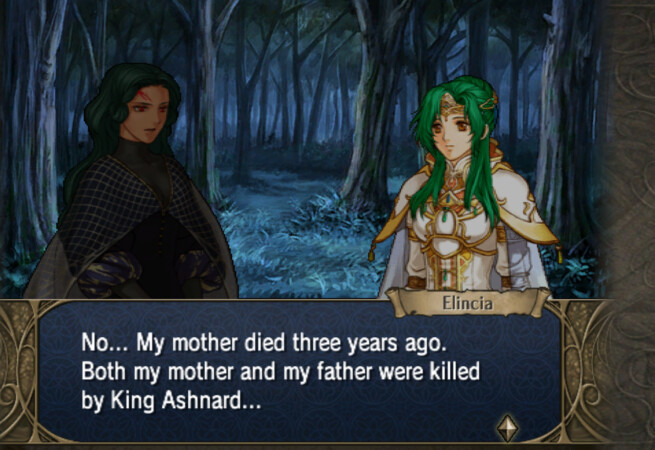
There are a few exceptions. Elincia talks with the widow of her parents’ killers, and Sanaki has a small subplot about admiring Micaiah and feeling inadequate over it (mostly removed in the localization), but these are fragments, not proper payoffs.
This is where the lack of supports hurts Radiant Dawn the most. None of the characters have time to give life to the world and story, but most characters are effectively just gameplay units at this point.
Even a good amount of convoy conversations would have been a reasonable compromise, but Part 4 shockingly has the fewest amount of them throughout all the game, and most of them are relegated to arbitrary late-game item rewards.
Nothing disappointed me more that getting finally arriving at the Tower of Guidance and seeing this.
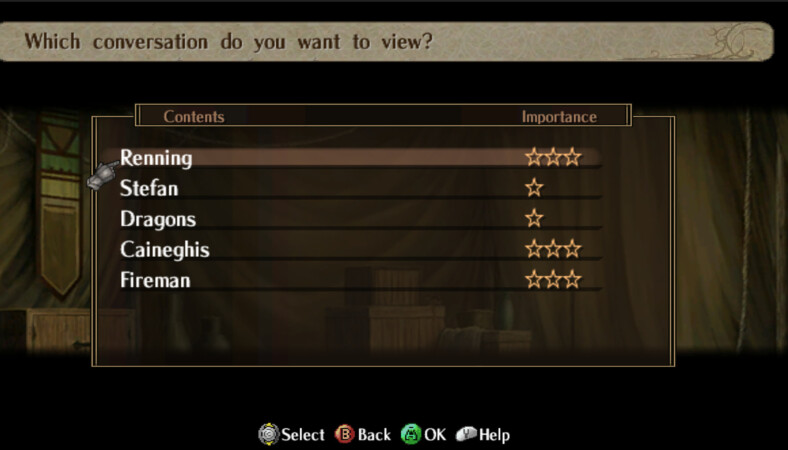
Even if they needed to stretch out Part 4 with the three-army structure, we could at least get a good moment just before the Tower.
Among these conversations, two are about getting a new character, one of them about getting a sum of gold, one about Branded lore, and lastly a plot-relevant one that announces some internal dissent in the Dragon Tribe.
So no one in Daein wants to talk with anyone in Crimea. No laguz is feeling exhausted despite being in a warrior tribe. Sothe has nothing to say to Tormod. Ranulf has nothing to say about Skrimir’s development. Really?
In Path of Radiance, it was not uncommon for certain Chapters to have as much dialogue and character interaction that this “endgame” has. Gritnea Tower is built up so much, and this is presented as a gigantic climax, a “final push”, but characters have nothing to say about it. You choose your army and go in.
Oh, speaking about the Tower of Guidance.
An Endgame Worth Preparing For?
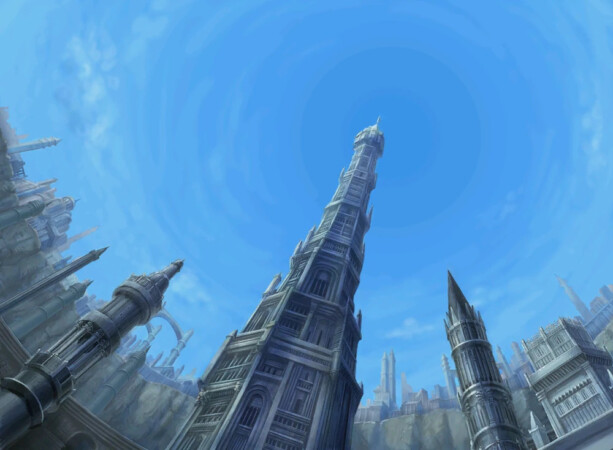
We haven’t had much time to talk about gameplay yet, but this is yet another part where Radiant Dawn is hard to review: despite the disjointed way units are recruited, Part 4 gives you enough experience to bring almost anyone to a proper power level for the Tower.
In repeat playthroughs, you can even plan ahead and create thematic teams: maybe in one playthrough you do “all low-tier characters”, or “all Daein”, or “all Greil Mercenaries”; this provides a great incentive for players to get creative and try out a bunch of weird strategies or team compositions.
What if it doesn’t work out, though, like in my New Mystery of the Emblem playthrough?
Well, you just get blatantly overpower characters, much stronger than anything you could hope to do, with no investment, and enough to fill out the entire endgame roster. I know that part of playing “growth characters” is going from zero to hero, but most of the time, these units will become stronger than late-game prepromotes, even if you don’t strictly need them.
In purely functional terms, then, why would I spend an ungodly amount of time and effort training Edward, Fiona or Rolf when Caineghis, Tibarn and Naesala can each individually solo the entire endgame? They are virtually unkillable, dish out more damage, and even get the most in-tower dialogue. Even for story reasons, the incentive is to ignore growth units.
The Tower therefore sits in a weird spot. It can become a fun challenge to see what you can get away with. But it’s also undermined by how much the game hands you its solutions for free.
An Incomplete Climax
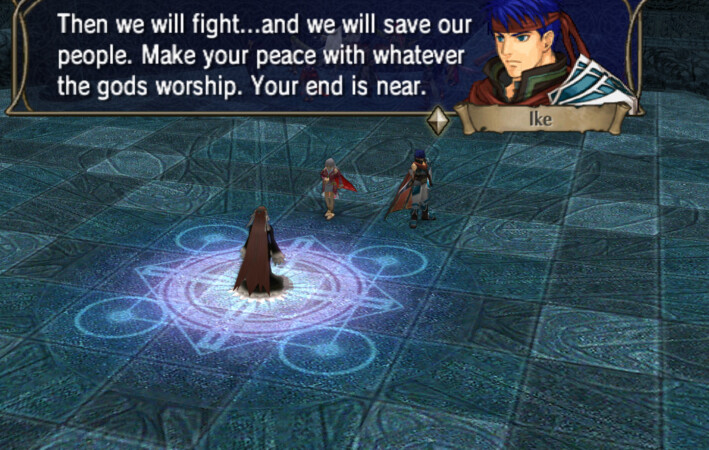
Despite the problems, the Tower of Guidance does succeed in some ways. The stakes are as high as Fire Emblem ever gets: you start fighting corrupt politicians and end up slaying a literal goddess. The thrill is undeniable.
But from a narrative perspective, it also fees unfinished: Micaiah does almost nothing, and Ike’s character is the only one given any focus in your army. Elincia is not even required to join, and even if she does, she has one optional line of dialogue and an optional boss conversation.
And when we kill Ashera, the whole world just magically goes back to peace for no explanation. I guess that the game couldn’t possibly be stretched to a Part 5, but there is no reckoning, no rebuilding, no fallout. It feels like everything was just cut short.
Conclusion: Do I Still Love This Game?
I have been very harsh on Radiant Dawn. It might seem that I want the game to be this unreachable masterpiece, and that I setup myself for disappointment. But Path of Radiance proved to me that a game can be as tight and well-written as the standard I held for it; indeed, this last playthrough might have been the time that I enjoyed Path of Radiance the most.
I don’t think I am entirely to blame for putting so many expectations on Radiant Dawn, either. It’s very evident that this was developed with an ungodly amount of ambition, and it had to both be a payoff to its prequel and maintain its own original story that needed to include a fight with the goddess.
But the longer the game goes on, the more evidence piles up against it. Part 1 was forgivably mid. Part 3 is amazing in places, but held together by contrivances. And in Part 4, everything falls off a cliff and we’re left with only the bare essentials of a functioning story.
…So, how did I feel when I finished Radiant Dawn and the credits started rolling?
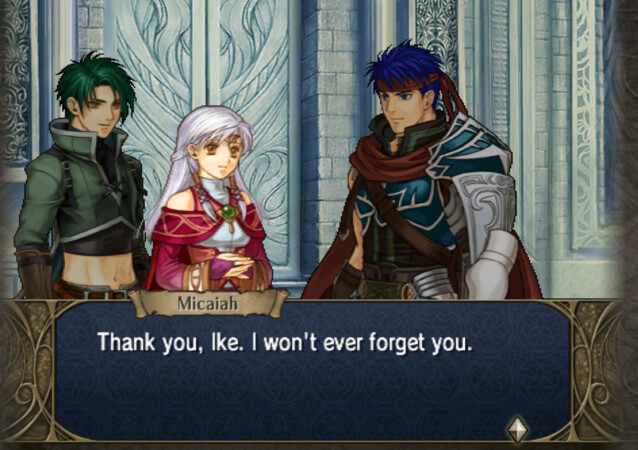
Despite everything, I felt so emotional I started crying. This is one messy game, and maybe as a final product it is not deserving of all the time and love I have poured into it.
But dammit, it tried.
It tired to be a sequel to a tightly-written game that setup a lot of its major plot points and characters. It tried to expand on radicalization and how it breaks upon personal loss. It tried to intertwine three different countries into an existential conflict with no easy solutions. It tried to be everything, and on its high moments, it is much better than anything that Path of Radiance ever offered.
But ultimately, Radiant Dawn is less than the sum of its partcompls. A great story on paper is bogged down with weird pacing, plot holes, unrealized characters and a flat cast. It frustrates me how much it had on its shoulders, and how much better it could be.
I could spend maybe 8,000 more words further saying all the other things that left me with disappointment, such as the handling of Pelleas and Sanaki, Ike suddenly disappearing at the post-credit scene for literally no reason, Elincia’s unceremonious ending scene… but I think I have spent enough time criticizing how incomplete Radiant Dawn feels.
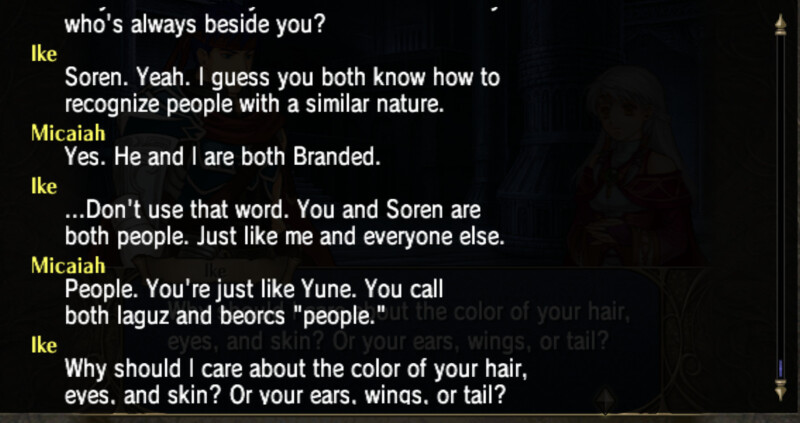
…And yet, I cannot stop recommending this game. In the almost two decades since it has been published, I cannot think of any other game that tried to do this much, and as a duology, did succeed at doing so much.
I know it sounds cringe, but I now see a lot of the values I admire in Ike. He is strong, kind, and he gives everyone a chance to prove themselves. He is not bound by prejudice. In replaying the Tellius games, I have started to consider that the imprint Tellius had on me is much more than “good game” or “ambitious sequel”; it might very well had shaped the values I now have as an adult, and the type of leaders I’d like to see in the world.
Like it’s prequel before it, Radiant Dawn feels much more prescient in 2025 than in 2007. It humanizes radical characters, gives several sides of the same conflict, shows both corrupt and honorable leaders, and despite the immense suffering of everyone involved, it still provides a resolution where everyone can still set aside their differences for mutual benefit.
Despite it’s flaws, nothing else in the medium has reached for so much. No duology has tried to make so much as Tellius, and I don’t know if there will be another thing like it again. Tellius stays with me not because its perfect, but because it dared to try. That is why, despite its many critical flaws, I still treasure it.