The first time I played Hollow Knight, I admired it. It showed me a game with good mechanics, tight progression, and enough of a story to keep me invested. I ended up playing it to around 80% completion, which is unusually high for me, and dropped it before I got to the true ending.
This second time, I loved it.
But it’s only now, trying to write about it, that I realize how hard it is to pin down. I’ve walked away with a much stronger admiration for it, appreciating how everything comes together to make an exceptional experience, and a great example of something that games can do uniquely well: tell subtle, nuanced stories, immersing you all the way through it with no interruptions.
This review is therefore not only about what the game does well, but also how the very things that make it exceptional can also make it exhausting, all while talking about things like story design, accessibility, and player agency.
An Effort of Love
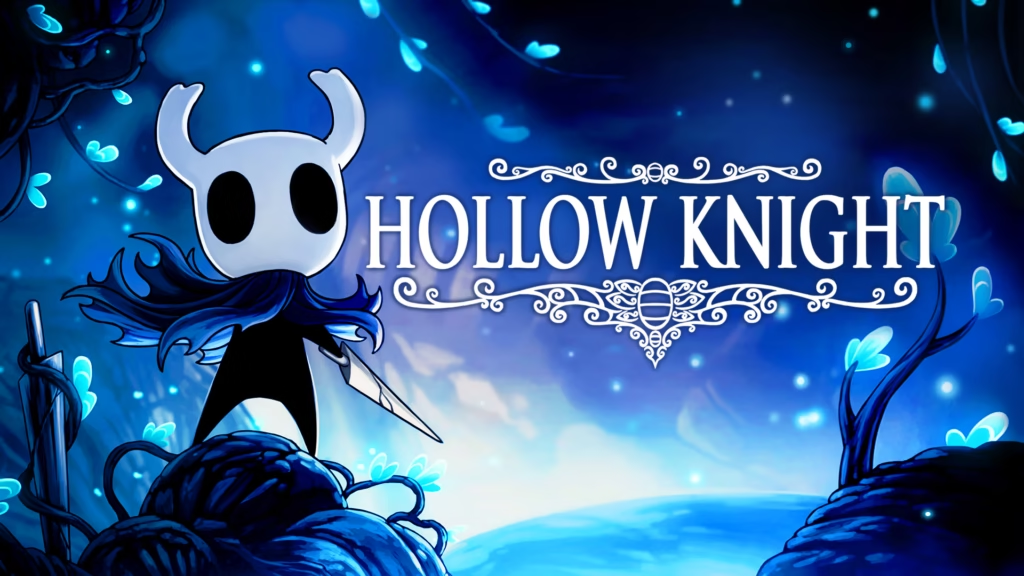
Probably the first thing that you’ll notice about Hollow Knight, and one of the things that made it famous, is its hand-drawn 2D animation. It is beautiful, with an intro that instantly sets the tone for a reflective, mournful atmosphere.
It also doesn’t waste your time with long expositions or overtly long tutorial sections, respecting your time and your agency as a player: it hooks you with a short, two-minute intro, then it gives you control of its player character, the Knight, immediately.
This game features one of the strongest art directions I’ve ever seen, giving a sense of entering a destroyed and forgotten kingdom, which slowly unravels its story as, in classic Metroidvania fashion, you unlock more abilities which let you access more areas.
Every area feels unique from each other, with unique backgrounds, (mostly) unique enemies, and each one sporting a boss, which will skill-check you at every step—and with a difficulty curve that teaches eases you into the game right as soon as it starts.
On that note…
Accessibility in Gaming
As I’ve started to play more games with my roommate, the idea of games being more available for a wider audience has been more prescient for me, as she struggles with even easier games like Battle for Bikini Bottom. Hollow Knight is a fairly challenging game, even for veterans, so of course she struggled with it.
However, my position has been for a long while that, in regards to difficulty, most games are better off with either more subtle accessibility features, preset difficulty options in a few cases, or no accessibility features at all—in Hollow Knight, you are exploring a dying kingdom, and I think a lot of its thematic weight and feel would be lost if it let you choose your own preset difficulty, or it it was simple and obvious how to trivialize it.
Thankfully, Team Cherry had a much smarter solution: they ramp up the game’s difficulty very gradually at first, with simple enemies and linear level design in its first couple of hours, but also with what enemies they show, how they put bosses in your way, and how powerful the Knight can get as you progress through the story. This subtler way of easing players into the game is what a lot of games concerned about accessibility should strive for: sometimes difficulty presets make sense (like in Fire Emblem), but for certain games you would rather have something curated and that lets the player face the world in the same way its character this.
I still had to do most of the bosses, of course, but well… Here’s what she has to say:
Casual Corner—A Worthwhile Struggle
Being a player that doesn’t have a lot of dexterity in handling characters, it’s a game that I enjoyed. The tasks that the game demands of you to develop your abilities at the start of the game are in concordance for the difficulty at later parts of it (still not enough for me).
That said, the thing that drew me over for this game was the aesthetic from both the main character as well as the environments, which makes the stress of not clearing through certain sections or sections more bearable.
In my opinion, if you are a player that values the story that a game tells and their aesthetics, this game should definitely be on top of your list.
This ties back to my earlier point: she enjoyed the game and she would probably be able to beat it eventually by herself. She improved steadily as time went on! While she never beat any later bosses, she eventually got adept at traversing through the world (albeit slowly and carefully), and was eager to do so every time I got through a critical checkpoint. She’s quick to mention her struggle, but not her steady growth—something that Hollow Knight quietly encourages through its design.
This is an important reflection for me: accessibility in games is not only about difficulty, but also about teaching players how to navigate your games. Struggling players can ask for help, look for guides, or grind the game more, but I think developers should never sacrifice artistic integrity for the sake of more players getting through their game.
There is one thing that she found a lot easier to do than I did, though.
Narrative Tease, or Narrative Gap?
Hollow Knight’s story is so subtle that the first time I played it I didn’t even catch most of it. This has its advantages: games being too heavy on the exposition side have started bothering more and more with upcoming years, and there is a lot to be said for games that use game mechanics as storytelling devices.
This game is the gold standard for that: if you watch something like a Mossbag video, you will see how much he draws on gameplay to make assumptions about the world. This makes the world feel real and like you’re having a direct impact on it, instead of simply being told that that is the case.
But does that maybe make the game more incomprehensible?
If you are interested in the lore, you can watch the last video. A lot of the “biggest mysteries” involve massive holes about major players of Hallownest, which makes the story feel incomplete at some points. It’s hard to tell whether the ambiguity is a deliberate artistic choice, or simply the product of “vibes-based” storytelling—but in a world characterized by decay and lost memory, that very doubt might be the point.
That is to say: I want to know more, dude. I want to know what the White Lady is, and how she acted during Hallownest’s golden days. I want to know the specific reason no one could contain the infection.
But is that really a criticism?
I am quite literally saying, “I want to know more about this world”, and perhaps I only want that because the game teases me so much with it, and from a thematic standpoint, it actually makes a lot of sense: Hallownest is a fallen kingdom, and scrounging for records and piecing things together fits the setting of a lost and ruined kingdom.
Still, I can’t shake the feeling that maybe, at certain junctures, Team Cherry could have given us more direction, both in the main quest, and in the lore of the game, so that instead of feeling like I am getting teased, I got a full story.
Breadcrumbs of a Buffet Story
Part of what made Hollow Knight not connect with me as strongly in the first time was that I felt like the story was saying… something to me, but other than vague ideas about an infection, I really had no clue what was going on.
With the lore content I have consumed over the years, and the help of my roommate who is a lot better at picking up context clues, I found a good amount of detail and nuance in the story that I had not initially seen. Even things as small as background details become character-defining traits under this observant gaze.

Background details, scattered texts, and the very, very small amounts of dialogue tell an incredibly compelling and nuanced story about the fallen kingdom you will be exploring, with competing interpretations giving characters a surprising amount of nuance when they might not even have more than a few minutes of screentime in the game.
This is compounded by how your curiosity is generously rewarded: not only does it give you goodies and abilities for knowing its world, but a lot of its narrative thrust is put between its incredible bosses and challenges. Perhaps the most extreme example of this is the Path of Pain, an incredibly arduous platforming challenge that took me around 3 hours to beat… the reward being a 2-second cutscene (TOTALLY worth it).
I talked about this in my recent Ghost Trick review, but I think there’s a lot of value in gameplay and story integration: in Hollow Knight, they create a nice feedback loop where story is told mostly through contextual clues in gameplay, and the story is framed as something as valuable for the player.
Speaking about the gameplay…
Metroidvania at its Best
Hollow Knight follows the Metroidvania formula down to a T so much it might become an archetypical example for it, rejecting any RPG mechanics or mandatory strength checks for a much more natural way of exploring its world.
Each upgrade marks a prerequisite for entering a section, of course, but these are not, for the most part, arbitrary movement restrictions like, say, in CONVERGENCE: most of your upgrades have an impact in how you move around the map, and a lot of implications for combat. The game starts out really simple, with just 4-direction slashes and a jump, and it will end with you bouncing on walls, hitting a down-air slash to reset your double jump then dashing to avoid enemy damage. It scales up naturally and magnificently.
Like I mentioned earlier, the first couple of sections are fairly linear, but it really opens up after that. If you, for example, take a look at speedrunning, even they have different routes depending on what areas they want to traverse.
Thus how different people experience Hallownest can be drastically different, with every area having different access points depending on how you get to it. In this run’s case, there were several side characters that didn’t even show up (like Cloth), characters that came up way more often (like Zote), and in this case we actually got through the good ending, which I did not do last time.
I can say this from experience, having just done my second full run of the game. The way my roommate discovered areas, got upgrades, talked to NPCs and generally progressed to the story gives the world a lot more flavor and immersion than it would otherwise have. While there are prerequisites for areas (skippable according to speedruns, but this was a casual run), you can actually just explore at your own will and the game will reward you at every step of the way for it, which is honestly incredible how well this captures the feeling of scrambling through a kingdom that shows remnants of being great, but no longer is.
The customization does not end there, with optional objectives like a skill system (called “Charms” here) giving you a surprising amount of variety of playstyles, offering support for spell-based builds. close-combat builds, or even heal-based or defensive paths. Exploration is tied to upgrading but your Nail (a sword by any other name) and letting you get more Charms, meaning you will also scale with power in a very organic way.
I much prefer systems like this over pure stat-based progress, as it feels much more meaningful and speaks more to player progression instead of character progression. I actually become wary of RPG systems in Metroidvanias now; if any Metroidvania wants players to engage meaningfully in character growth, they should take a lesson from Hollow Knight and invite players to master their systems, and reward their exploration, not encourage them to grind out stat boosters.
This might be, however, where this game’s cracks start showing…
Lost in Hallownest
One of the more internally divisive thoughts that I have on Hollow Knight comes when I start considering its pitfalls, which are created by the same thing that made it so great. Exploring Hallownest was an incredible experience, each area offering some sort of lore and gameplay reward, giving it a very real “fallen kingdom” feel.
But that very same open-endedness can be its own problem. In both occasions that I was playing Hollow Knight, there was a point where I started thinking, “okay, enough exploring—let’s actually move the story forward”, only to start pixel-hunting in the map and going to edges of the screens just to see if there was some sort of new area I had not explored, then encountering something that did not necessarily put me ahead in what concerned the main story.
My roommate never got tired, though, intentionally delaying doing the main objective to get more out of the world, but I did get tired at some point, I wanted the story to continue because I was so deeply invested in Hallownest.
I can’t say that I had zero issues with it, though.
The Cost of Subtlety
I want more because of what exists here is so great already: when Hornet shows up for the trigger of the true ending, I could feel tears forming in my eyes just by how good everything was. All the moments that have explicit lore feel very meaningful, perhaps not despite the lack of answers in the rest of the game but because of them.
I also can see how someone could be completely content with this: my roommate never has expressed this experience, and has not actively sought out lore dumps in order to piece together the story; she seemed fine with what she have.
One of my favorite parts in the game is the second duel with Hornet, which perhaps lands better because of Hollow Knight’s structure, not in spite of it. It carries monumental implications for the lore and is a very important trigger for the true ending, making its combination of mechanical complexity, story delivery, and ambience feel very climatic and impactful.
Even if you knew nothing about the story, this small excerpt will probably feel like it’s delivering on something.
This is not the only moment that hit this hard upon a rewatch: when I understood why the final boss acted the way it did (if you know, you know) and it hit me like a sack of bricks—there is no way to do something that hits this hard through story alone, it’s an intentional artistic choice to leave it up to the player.
Would any of these moments land as hard if the game wasn’t structured about trusting me, the player, with agency and direction in how I experience its story? I really don’t know. I feel like moments like this are definitely sparse, and there were a few hours in the game where I did feel that I was not moving forward, and could have seen a bit more development, but I also wonder if this Hornet fight or the final boss would have hit as hard if I wasn’t told the story this way.
Final Verdict—Looking Ahead for Silksong
Regardless on what camp you land on, Hollow Knight is an incredible experience: even if you get little to nothing out of the story, it’s a mechanically tight game, that expands and deviates from it as you grow, it is a very customizable experience, it scales with your skill level (first run will take you around 20 to 25 hours, while skilled runners usually clear it in 2 to 3 hours), it has pristine aesthetics, and it has some very good moments in the gameplay-and-story integration department. I haven’t even gotten to how good the soundtrack is, knowing when to stay quiet and in the background, and knowing when to accentuate key scenes.
I almost regret being this one of the first games that I played to completeness with my roommate, as now I have simply put the bar too high to play something else, and indeed, the shoes that Hollow Knight has left empty will prove hard to fill.
Hollow Knight was not only an incredible game, but one that has lingered with me. I obsessed over its lore over weeks, and played it way beyond regular completion, hoping to get as much out of it. I felt invested in it, and I can’t decide if I want it to tell me more or thank for resisting my desire for more answers.
And maybe that’s the point. Maybe in Hallownest, the things left unsaid are the ones that stay with us the longest.